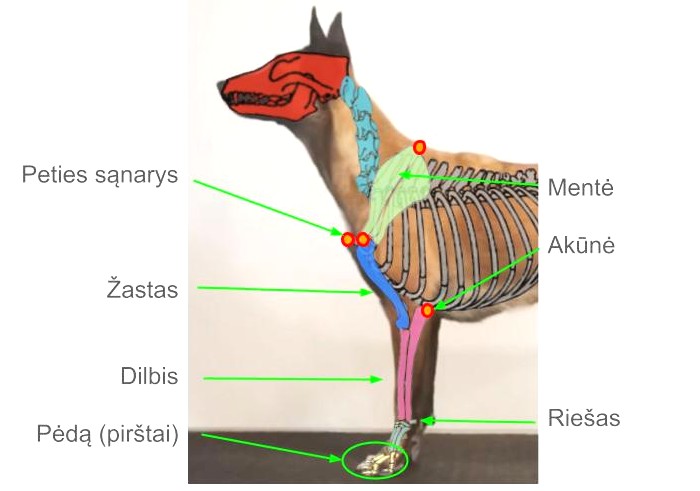
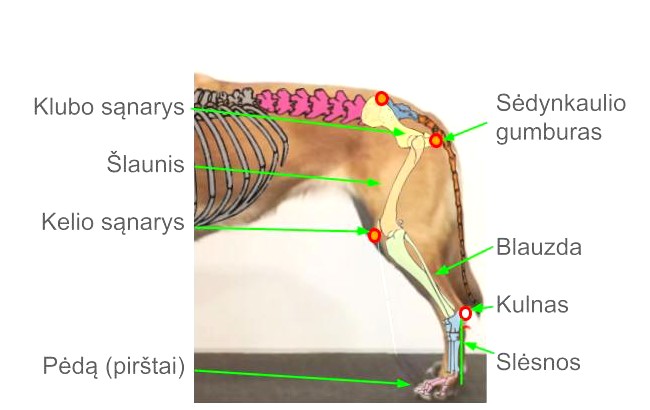
The site frequently mentions various dog body parts, locations, points, and lines. So you need to briefly familiarize yourself with the anatomical terms most commonly used in fitness.
an imaginary line drawn from the nose to the base of the skull
the bone that connects the ribs at the front and bottom of the chest. We often refer to the top edge of the sternum as a landmark when we want to measure a dog’s length.
an imaginary line drawn from the dog’s withers to the pelvic bones. In most breeds it should be straight, without curves, and horizontal.
we can measure a dog’s length from the top point of the sternum to the ischial tuberosity, or from the front to the hind paws if the dog is standing correctly.
the length of a line drawn vertically downward from the withers.
Front leg. Unlike the human arm, a dog’s front leg attaches to the body only by muscles, meaning it does not have a clavicle-scapula joint like humans do. Dogs carry about 60 percent of their body weight on their front legs. This percentage may vary slightly depending on the breed.
Hind leg. Dogs walk on the ground resting only on their toes, while humans stand on the metatarsals and heel bone. Because of this, there is often confusion about where a dog’s heel actually is. The hind leg metatarsals define the hock line.
Although the hind legs have greater muscle mass, they carry only 40 percent of the body weight.