


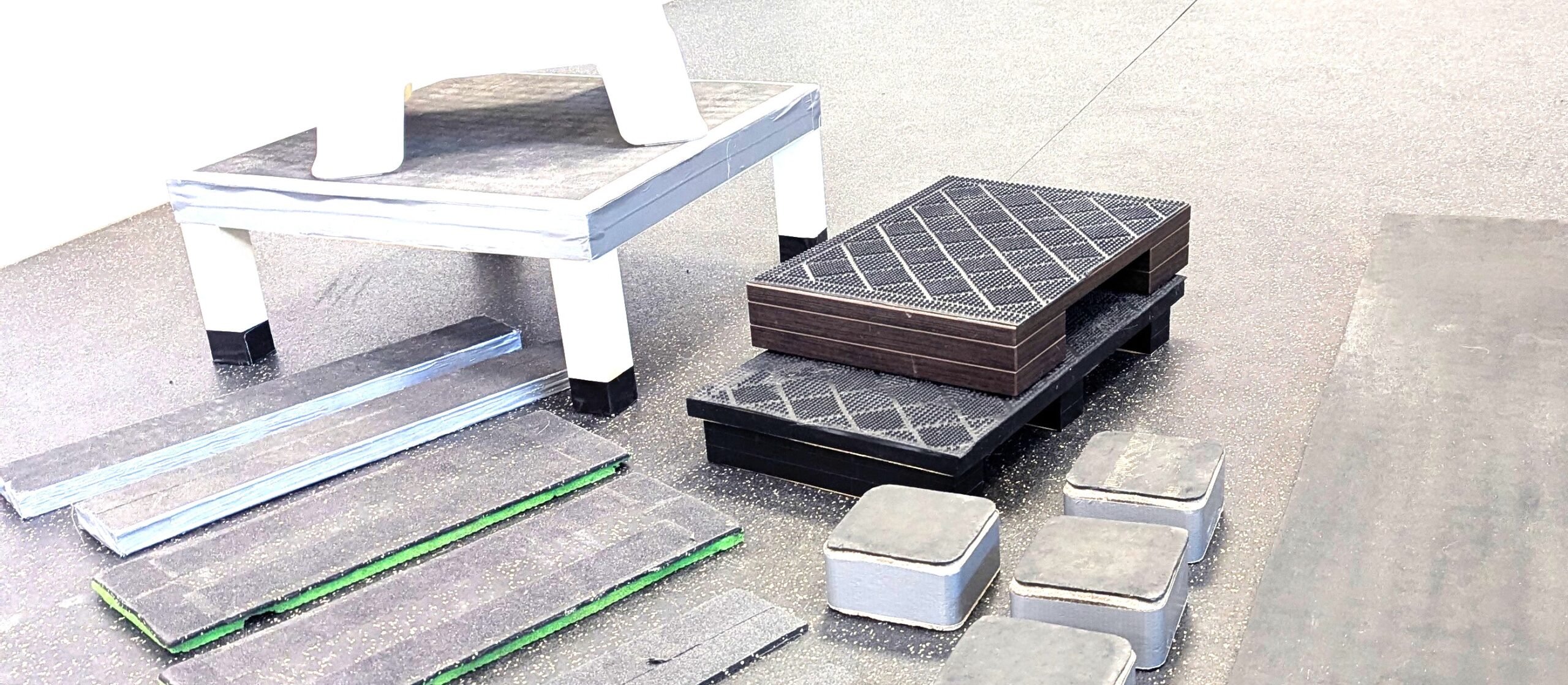
If all you know about dog fitness is what you’ve seen in promotional clips, I have to disappoint you – it’s far from just standing on a donut or rolling a ball. In reality, only a small portion of fitness exercises are performed on balance equipment, while the bulk of the core work is very down-to-earth, on stable platforms and targets.
The main fitness tools – platforms and targets.
Beginners often ask why platforms and targets are needed? Why can’t exercises be done simply on the ground?
You can, it’s just that using platforms and targets makes it much easier and simpler to explain to the dog what we want from them. And we want them not just to change position from sitting to standing, but to change it with a specific movement pattern.
When doing one exercise or another, we have a clear goal for why we’re doing it, i.e., we aim to activate certain muscles. By changing the movement pattern, the most actively working muscles will also change. So when we want the dog to stand up from a sitting position, we want the front legs to move in one case, and the hind legs in another exercise. And these are two different exercises with different movement patterns, even though the final positions in both cases will be the same – sitting and standing.
When doing an exercise on targets, the dog automatically moves less and understands much more easily what to do with which limbs. All of this helps to capture the correct position in time and reward it.
Main Types of Platforms
The most commonly used platforms. Their names directly reflect their purpose, i.e., a sitting platform is for the dog to sit on, a standing platform is for standing and lying down, paw targets are just for stepping on with paws. It’s best when platforms are custom-made for the individual dog, then the benefit provided by the platforms will be maximized. Of course, you can find ready-made equipment that would suit your dog. You can choose what’s more acceptable to you in terms of price and appearance, but you should always prioritize functionality, i.e., whether the platforms will serve their purpose and be safe for the dog.
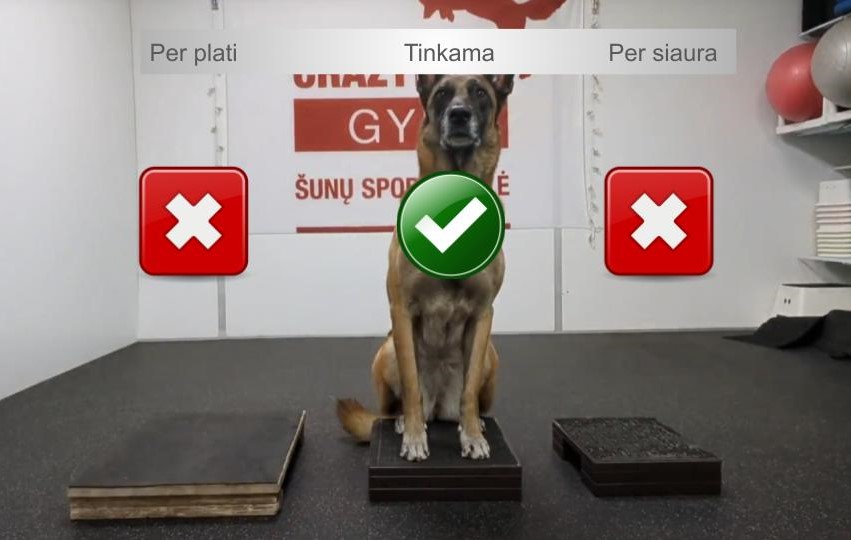
Sitting platform. These platforms are short and narrow. They limit the width and length of your dog’s paw placement. They help keep the dog in a confined space, without moving. They also provide the dog with information about what they shouldn’t do, e.g., not lie down.
The most useful of all platforms and it’s advisable to have several identical ones, then they can be stacked on top of each other to achieve the perfect height for ideal movement.
Also used in various combinations with other platforms in advanced and expert level exercises.
Standing platform. These platforms are long and narrow. They limit the width of the dog’s paw placement but encourage the front and hind legs to be placed far enough apart from each other (length). A longer platform provides the dog with information that they’re allowed to place their front paws farther from the hind paws than on a sitting platform.
In higher-level exercises, these platforms can be combined by placing them on an unstable inflatable base to make the exercises more challenging. Or create a downhill/uphill to load the front or rear part more.
Paw targets. They provide the dog with information about a very specific paw position and maximally precise posture. Paw targets can be for both front or hind paws, or even smaller – for each paw separately.
Platform Sizes
Sitting Platform
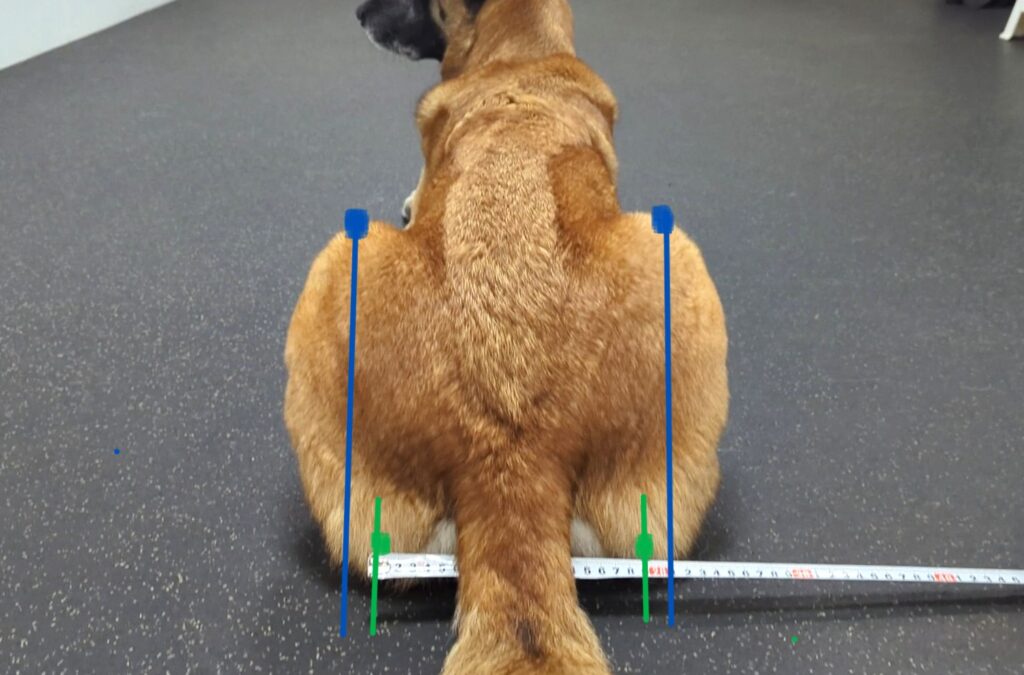
The sitting platform width is calculated by measuring the distance between the dog’s hocks and stifles in a lying position and finding the average between them + 10%.
Let’s look at an example in the photo: the distance between the hocks is 20 cm (green lines), the distance between the stifles (blue lines) is 26 cm, so the platform width is 23 cm + 10% = 25 cm.
The platform length is calculated by multiplying the width by a coefficient of 1.5 – 2.5
25 cm x 1.5 = 37.5 (40) cm or 25 cm x 2 = 50 cm.
Which coefficient we use depends on the dog’s format (square or elongated). If the dog’s height equals the dog’s length – the coefficient will be 1.5. If the dog is of an elongated format, i.e., length is greater than height, the coefficient will be 2 or 2.5.
The platform height is recommended to be about 0.5 of the dog’s hock height. For example, if the dog’s hock is 12 cm from the ground, the platform height is 6-7 cm.
Standing Platform
Its width and height are calculated the same way as the sitting platform’s width and height.
The standing platform length equals the length of a properly lying dog from the front paws to the hock (green line) and + 10% (blue line).
For example, the distance from the paws to the hock is 100 cm + 10% = 110 cm platform length.
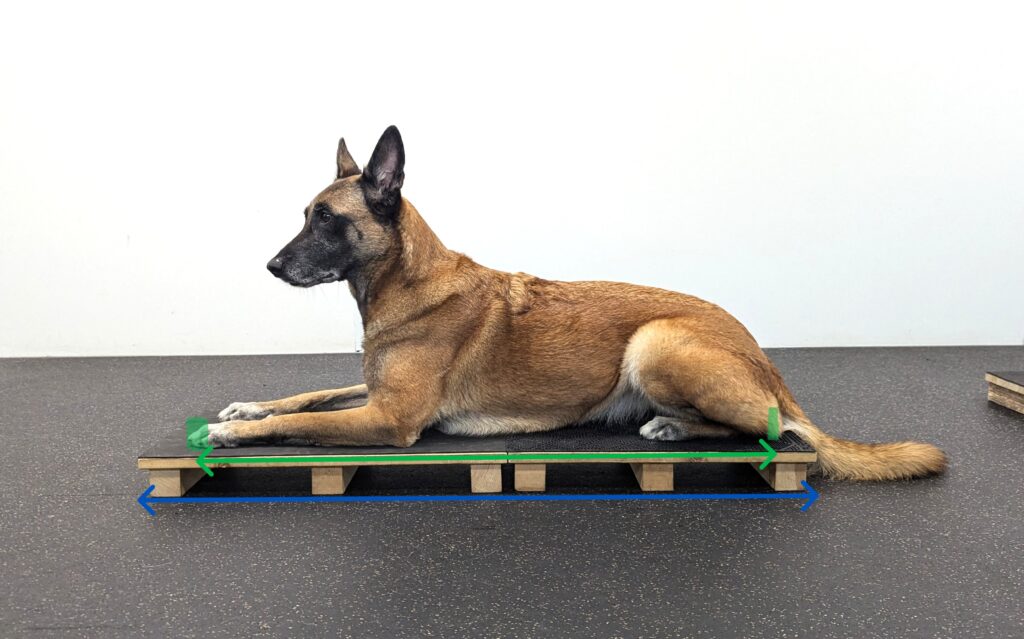
Instead of one long standing platform, you can use two separate shorter platforms (sitting and intermediate) placed one after the other with their short edges together. The intermediate platform length is calculated by subtracting the existing sitting platform length from the standing platform length.
For example, if the standing platform needs to be 110 cm long and the sitting platform length is 50 cm, then the intermediate platform would be 60 cm long (110 – 50 = 60).
Paw Targets
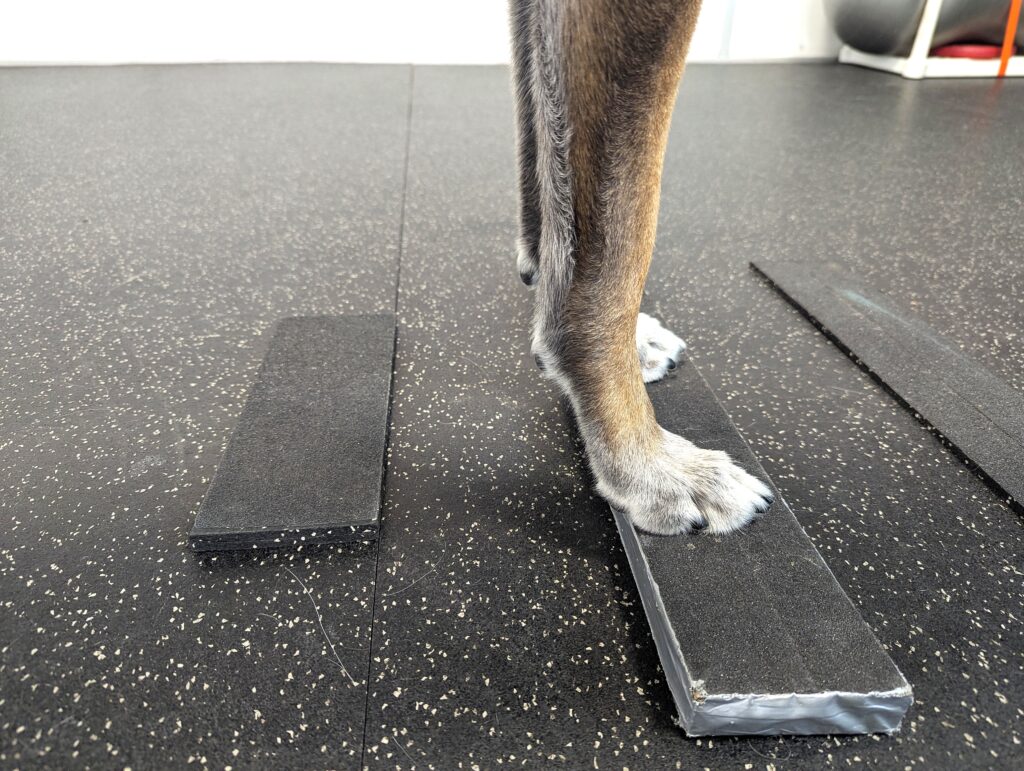
Paw targets are low, 1-3 cm high, stable targets. It’s useful to have targets of two widths.
- narrower ones, whose width equals the length of one paw
- twice as wide.
It’s also useful to have targets for individual paws (e.g., bricks).
General Equipment Requirements
Several general requirements apply to all equipment and no exceptions are made in this regard:
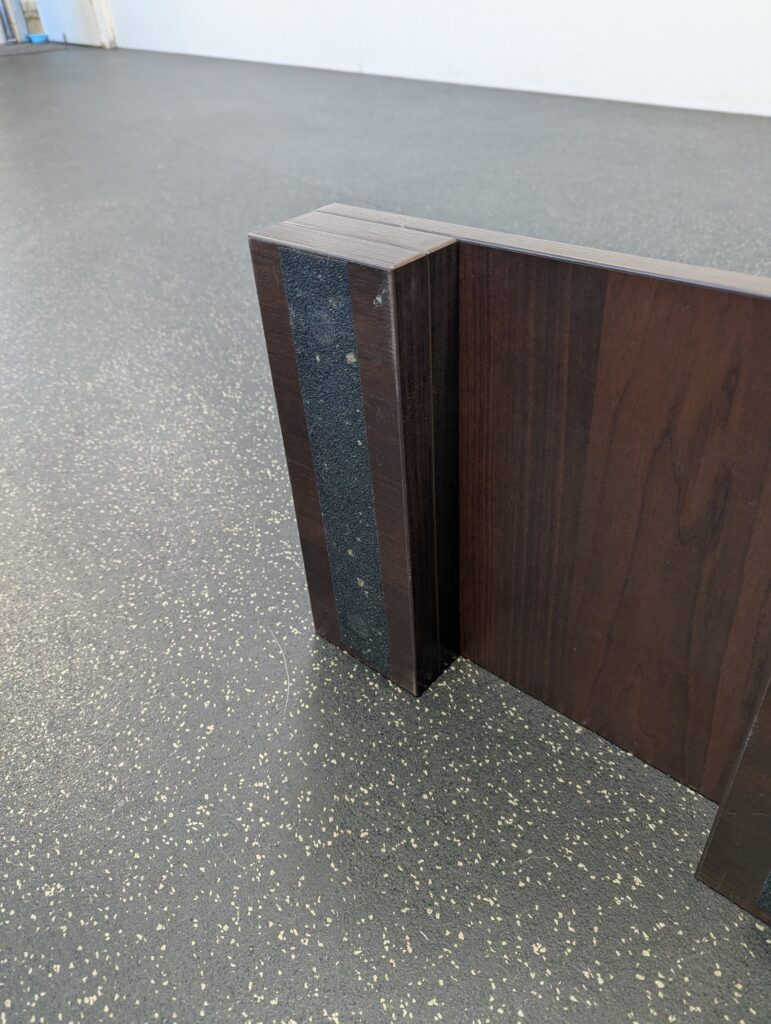
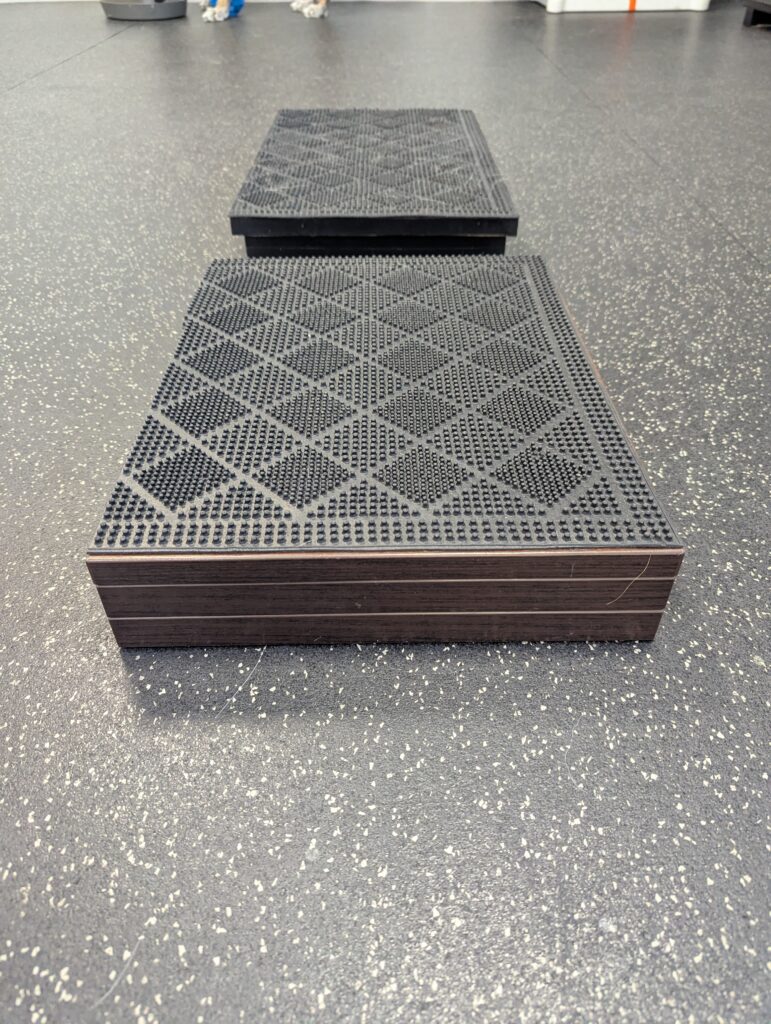
- non-slip working surface (rubber, yoga mat, rubber door mats, poured rubber, grip tape),
- non-slip base (bottom of the platform),
- platforms are stable, heavy enough not to tip over or slide from the slightest dog movement,
- without sharp protrusions, corners, holes, or gaps.
Grip tape glued to the base protects against slipping
A rubber mat glued on top guarantees good paw grip with the surface
General Room Requirements
Platforms alone won’t be enough for successful work. You need to have somewhere to place them. The surface on which you place the platforms must also be non-slip. When working at home, you need to lay down a good-grip surface – yoga mats, a regular thick carpet, sports hall or children’s playroom interlocking flooring, and similar. In good weather, you can work outdoors – short-cut dry grass, a well-raked level sand area. The surface should cover not only the space occupied by the platforms but also around them. The area depends on the dog’s size – you need the dog to be able to freely step off the platform after completing the exercise and giving the “free” command, walk at least 4-5 steps, and turn around.
Keep in mind that some dynamic exercises require enough space, which will be mentioned with individual exercises.
It’s especially useful to have a mirror in which you can see the whole dog from the side, even though you’re standing in front of the dog.

Want a strong, fit dog the safe way?
Browse our dog fitness courses